Table of Contents
There are many different elements in chemistry, and each one has its own physical and chemical properties. Some elements are shiny and good conductors of electricity, while others are gases or brittle solids. Studying every element separately can be difficult, so chemists organize them into groups based on their similarities and differences. This systematic arrangement is known as the classification of elements in periodic table. It helps us understand the properties of elements, compare them with one another, and predict how they may behave during chemical reactions.
The modern periodic table provides the most useful system for organizing the known elements. However, elements can also be classified according to their physical and chemical properties, electron configurations, and position in the periodic table.
Why Are Elements Classified?
Classification of elements in periodic table makes the study of chemistry more organized. Instead of memorizing the properties of every element individually, we can study groups of elements that have similar characteristics. The classification of elements in periodic table helps us to:
- Identify elements with similar properties.
- Understand similarities and differences between elements.
- Predict chemical behavior and reactivity.
- Study patterns in the periodic table.
- Understand how electron arrangement affects properties.
- Make the study of a large number of elements easier.
For example, sodium and potassium are both highly reactive metals and belong to the same group. Their similar behavior becomes easier to understand when they are studied together.
Main Ways to Classify Elements
Elements can be classified in several ways. The most common methods are based on their physical and chemical properties, position in the periodic table, and electronic configuration.
1. Classification based on physical and chemical properties
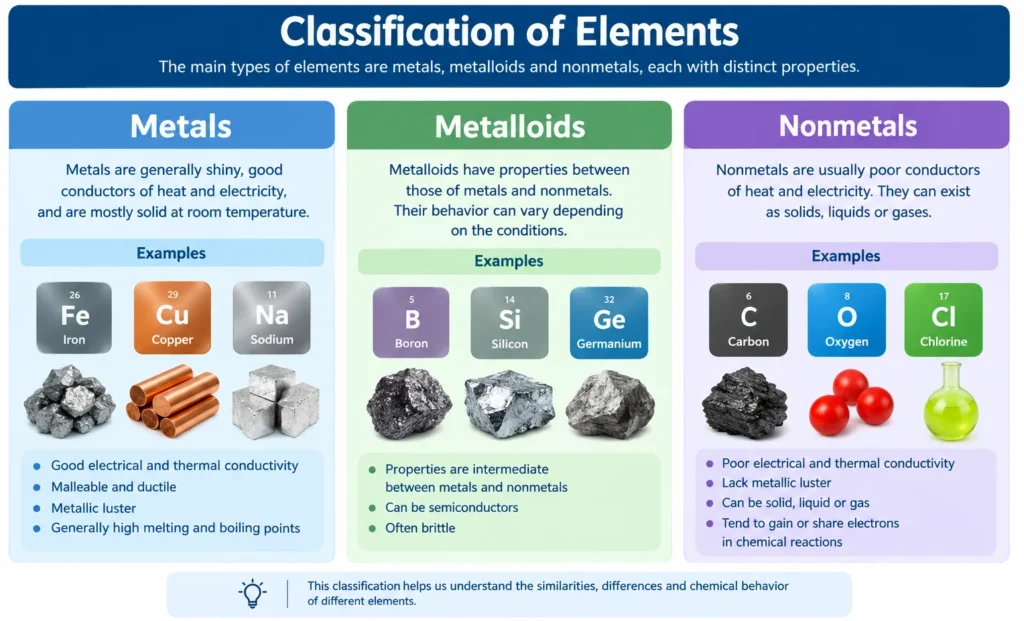
One of the simplest approaches is to divide elements into metals, nonmetals, and metalloids.
Metals
Metals generally have a shiny appearance and are good conductors of heat and electricity. Most are solid at room temperature and can be shaped without breaking. Examples include iron (Fe), copper (Cu), aluminum (Al), and sodium (Na). Common properties of metals include; good electrical conductivity, good thermal conductivity, malleability, ductility, metallic luster, generally high melting and boiling points.
Nonmetals
Nonmetals generally have properties opposite to those of metals. They are usually poor conductors of heat and electricity. Nonmetals can exist as solids, liquids, or gases. Examples include oxygen (O), nitrogen (N), sulfur (S), and chlorine (Cl). Some important properties include poor electrical conductivity, lack of metallic luster, and greater tendency to gain or share electrons in chemical reactions.
Metalloids
Metalloids have properties that fall between those of metals and nonmetals. Their behavior can vary depending on the conditions. Silicon (Si), germanium (Ge), arsenic (As), and antimony (Sb) are commonly classified as metalloids. Silicon is particularly important because its electrical properties make it useful in electronic devices.
| Category | General characteristics | Examples |
|---|---|---|
| Metals | Good conductors, malleable and ductile | Fe, Cu, Al |
| Nonmetals | Generally poor conductors | O, N, S |
| Metalloids | Properties between metals and nonmetals | Si, Ge, As |
2. Classification based on groups and periods in Periodic Table
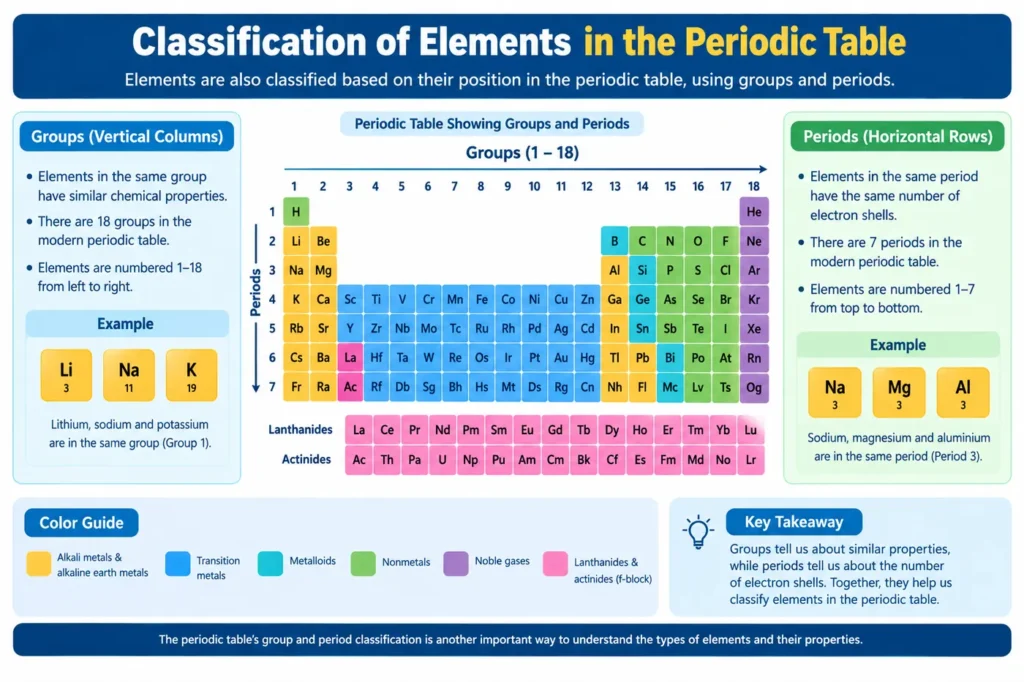
The periodic table is the modern system used for the classification of elements. Elements are arranged according to increasing atomic number. The table contains periods arranged horizontally and groups arranged vertically. Elements in the same group often have similar chemical properties because they have related arrangements of their outermost electrons. Some important groups include:
| Group | Common name | Examples |
|---|---|---|
| 1 | Alkali metals | Li, Na, K |
| 2 | Alkaline earth metals | Be, Mg, Ca |
| 17 | Halogens | F, Cl, Br |
| 18 | Noble gases | He, Ne, Ar |
For example, the noble gases are generally very unreactive because their outer electron shells are stable. In contrast, the halogens are highly reactive nonmetals.
3. Classification based on Electron Configuration
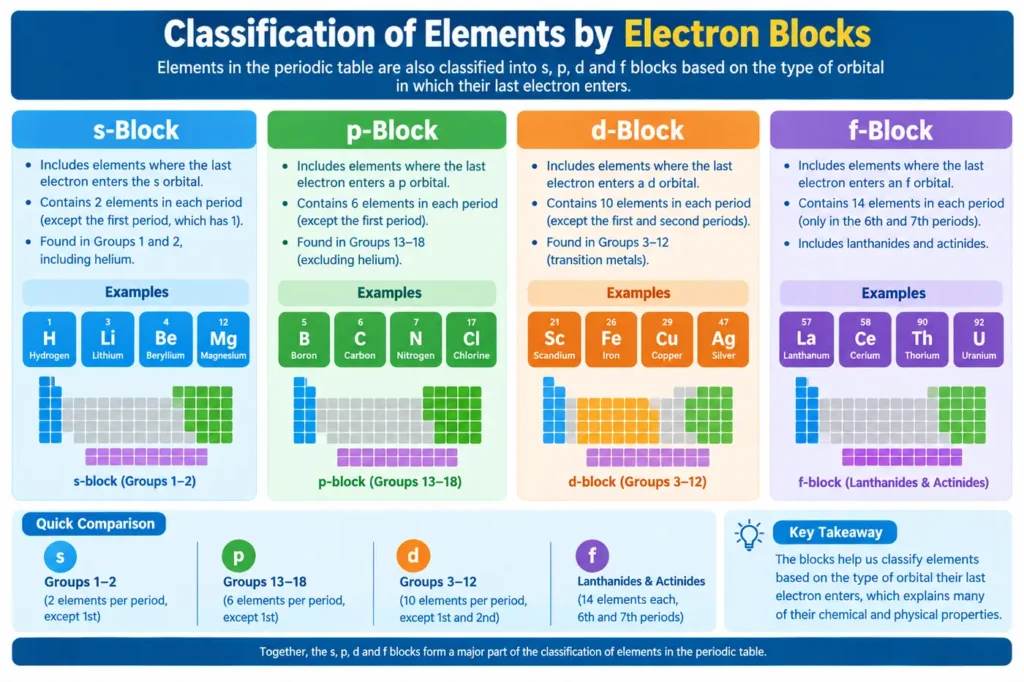
Elements can also be classified according to the type of orbital into which their differentiating electron enters. On this basis, the periodic table is divided into four major blocks:
- s-block
- p-block
- d-block
- f-block
The s-block mainly contains Groups 1 and 2. The p-block contains Groups 13 to 18, while the d-block contains Groups 3 to 12. The f-block contains the lanthanides and actinides. The d-block includes elements such as scandium (Sc), titanium (Ti), iron (Fe), copper (Cu), and zinc (Zn). Many of these elements are transition elements, although zinc, cadmium, and mercury are generally not considered transition elements under the strict definition because their d subshells are completely filled. This classification of elements is useful because electron configuration helps explain many properties, including bonding and chemical reactivity.
Common groups of Elements
Some groups have distinctive properties and are frequently discussed in introductory chemistry.
Alkali Metals
Alkali metals belong to Group 1. They are highly reactive metals and generally have one electron in their outermost shell. Examples include lithium, sodium, and potassium.
Alkaline Earth Metals
These elements belong to Group 2. They are reactive metals but are generally less reactive than alkali metals. Examples include magnesium and calcium.
Transition Elements
Transition elements are mainly found in the d-block of the periodic table. They commonly show variable oxidation states and often form colored compounds and complex ions. Examples include scandium (Sc), titanium (Ti), iron (Fe), copper (Cu), and nickel (Ni).
It is important to distinguish transition elements from the entire d-block: although zinc (Zn), cadmium (Cd), and mercury (Hg) are d-block elements, they are generally excluded from the transition-element category under the strict definition.
Halogens
Halogens belong to Group 17. They are reactive nonmetals and tend to form compounds with metals. Fluorine, chlorine, bromine, and iodine are examples.
Noble Gases
Noble gases are found in Group 18. They have very stable electron configurations and are generally unreactive under ordinary conditions. Examples include helium, neon, and argon.
Why is Classification of Elements Important?
The classification of elements is more than a method of organizing a table. It helps chemists identify relationships between elements and understand patterns in their properties. For example, knowing that an element belongs to the alkali-metal group gives useful information about its general chemical behavior. Similarly, knowing that an element is a noble gas suggests that it will be relatively unreactive. This knowledge is useful in chemistry, physics, materials science, medicine, electronics, and many other fields.
Classification of Elements and the Periodic Table
The different classification systems are connected. An element can be described according to its physical properties, its group and period, and its electron configuration. For example, iron (Fe) is a metal, belongs to the transition elements, is located in the d-block, and occupies Group 8 and Period 4 of the periodic table. Therefore, classification of elements provides several ways to understand the same element rather than treating each element as completely separate.
Conclusion
The classification of elements provides a systematic way to study the large number of elements known to science. Elements can be grouped according to their physical and chemical properties, their positions in the periodic table, and their electron configurations. The broad categories of metals, nonmetals, and metalloids provide a simple starting point, while groups, periods, and blocks give a more detailed understanding of elemental behavior. Learning these classifications makes the periodic table easier to understand and provides a foundation for studying chemical reactions, bonding, periodic trends, and other important chemistry concepts.
Frequently Asked Questions
1. What is the classification of elements in periodic table?
The classification of elements in the periodic table is the systematic grouping of elements according to their similarities, differences, properties, positions, or electron configurations.
2. What are the three main types of elements?
The three broad categories are metals, nonmetals, and metalloids. These categories are based mainly on general physical and chemical properties.
3. Why are elements classified?
Elements are classified to make their properties easier to study, compare, and understand. Classification also helps predict their chemical behavior.
4. What is the base of arrangement in the modern periodic table?
Elements are arranged in the modern periodic table on the basis of increasing atomic number.
5. What are metals?
Metals are elements that generally conduct heat and electricity well and are usually malleable and ductile. Iron and copper are examples.
6. What are nonmetals?
Nonmetals are elements that generally do not conduct heat and electricity well. Oxygen, nitrogen, and sulfur are examples.
7. What are metalloids?
Metalloids are elements that show a mixture of metallic and nonmetallic properties. Silicon and germanium are common examples.
8. What are the blocks of the periodic table?
The periodic table is divided into four blocks according to electron configuration: s-block, p-block, d-block, and f-block.
9. Are all d-block elements transition elements?
No. The d-block contains Groups 3–12, but under the strict definition, elements such as zinc, cadmium, and mercury are not transition elements because their d subshells are completely filled.
10. Why do elements in the same group have similar properties?
Elements in the same group generally have similar outer-electron arrangements. This contributes to similarities in their chemical behavior.