Table of Contents
Ready to learn and understand the basic concepts of chemistry! In this guide we will cover the basics of chemistry that are essential for learning and undrstanding the chemistry. It is practically accepted that if we do not know the basics of any subject, we cannot understand the other things related to that subject. In this article we will cover atom, element, compound, matter, substance, atomic number and atomic mass in simple words with appropriate examples.
What is Atom?
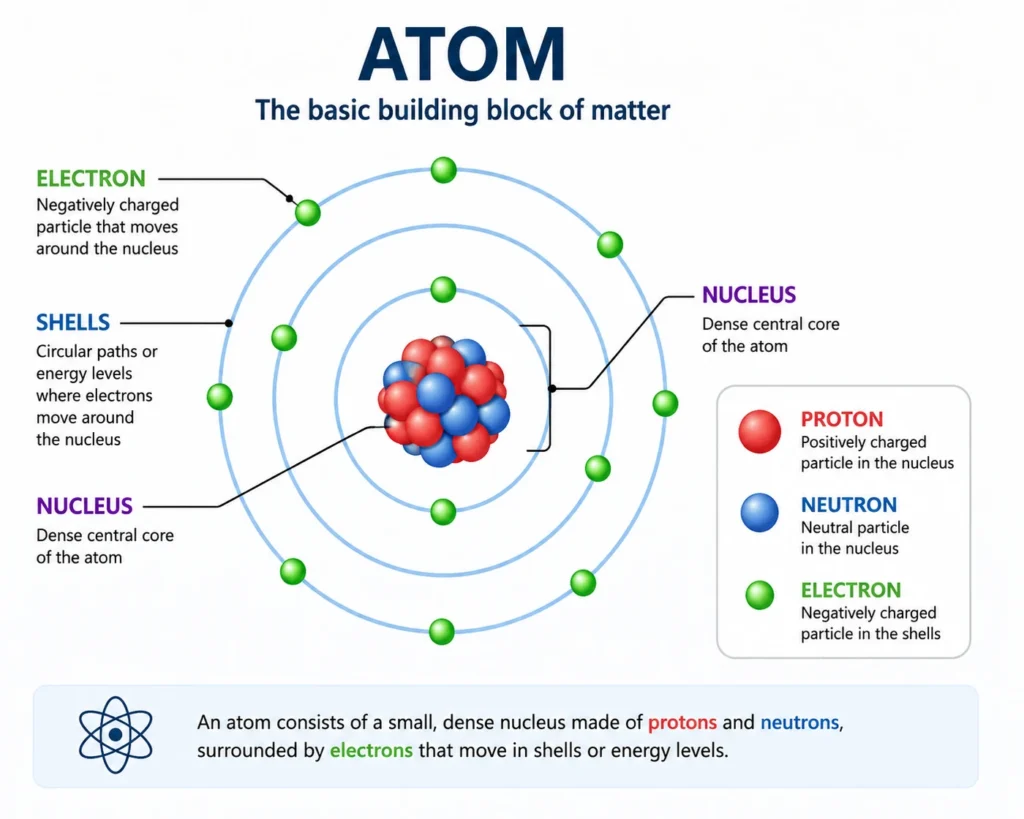
We can define atom as the smallest particle of matter that can or cannot exist independently and can part in chemical reactions. For example, sodium, magnesium, oxygen, etc. Initially, it was considered that atoms cannot be subdivided but lator it was discovered that atom broadly consists of protons, electrons and neutrons.
Some atoms can exist independently such as gold, silver, helium atoms. Existing independently means that they can stay as a single atoms. They do not need to combined with other similar atoms or different atoms. While some atoms cannot exist independently such as hydrogen, sodium, chlorine atoms. It means that they either combine with its own atoms or other atoms to become stable.
What is Element?
We can define element as the pure substance that cantains the same kinds of atoms and cannot be broken down into simpler components ( electron, protons, neutrons ) by ordinary chemical reactions. Examples of elements are carbon, platinum, magnesium, etc. Just like atoms, elements can or cannot exist independently. Elements are represented by symbols such as symbol of oxygen element is O. Symbols are element specific. It means no two elements can have the same symbol.
What is Compound?
We can define compound as pure substance that is formed when two or more different elements chemically combined together in a fixed ratio by mass. Fixed ratio by mass means that a fixed amount of one element can combine with fixed amount of other element. We cannot make 100 grams of H2O form 50 grams of H2 and 50 grams of O2. It depends upon the nature of reaction that how many grams of H2 and O2 will react together to form product H2O. Examples of compounds are H2O, NH3, C6H12O6, NaCl, etc.
What is Matter?
We can define matter as anything that has mass and occupies space ( volume ). Everything in this universe is made up of matter and energy. Matter exists in three primary states which are solid, liquid and gas. In which state a matter exists depends upon the strength of attractive forces between atoms of that matter. Plasma is considered as fourth state of matter but physically it looks like the gas state pf matter. So in broad way we can say that matter has four states. Everyting around us including us are examples of matter such as chair, pen, iron, fan, air, etc.
What is Substance?
We can define substance as pure form of matter while impure form of matter is mixture. Just like things in everyday life are pure or impure, similarly matter can be. In a broad way we can say matter and substance are similar things but as a chemist these are not similar. For example, NaCl in its pure form is would be called as substance.
What is Atomic Number or Proton Number of Atom?
We can define atomic number of atom as the number of protons present in the nucleus of that atom. Different atoms has different number of protons in the nucleus. Atomic number serve as the identity number for a specific atom. Just like identity card number for every person in country is specific, similarly atomic number is also specific for every atom. No two atoms can have the same atomic number. Atomic number is represented by capital english letter Z. For instance, atomic number of oxygen atom is 8 as it has 8 protons in its nucleus.
What is Atomic Mass or Mass Number of Atom?
We can define mass number of atom as the sum of protons and neutrons number in the nucleus of that atom. Contrary to atomic number, two atoms can have the same mass numbers. Atomic mass is represented by capital english letter A.
There is a formula to calculate the atomic mass of atom which is;
A = Z + n , where n is the number of neutrons in the nucleus of atom. By using this formula, we can calculate one term if other two terms are given.
For example, mass number of magnesium atom is 24 as it has 12 protons and 12 neutrons in its nucleus.
Frequently Asked Questions
1. What are the basic concepts of chemistry?
The basic concepts of chemistry include matter, atoms, elements, compounds, molecules, mixtures, and chemical reactions. Understanding these concepts provides a foundation for learning more advanced chemistry topics.
2. What is matter in chemistry?
Matter is anything that has mass and occupies space. It can exist mainly as solids, liquids, and gases. Matter is made up of tiny particles such as atoms and molecules.
3. What is an atom?
An atom is the smallest unit of an element that retains the chemical properties of that element. It consists of a nucleus containing protons and neutrons, surrounded by electrons.
4. What is the difference between an element and a compound?
An element contains only one type of atom, such as oxygen or sodium. A compound contains atoms of two or more different elements chemically bonded together, such as water (H₂O) or sodium chloride (NaCl).
5. What is the difference between a compound and a mixture?
A compound is formed when different elements chemically combine in a fixed ratio, whereas a mixture contains two or more substances that are physically combined and can generally be separated by physical methods.
6. What is a chemical reaction?
A chemical reaction is a process in which one or more substances are transformed into new substances with different chemical properties. For example, hydrogen and oxygen can react to form water.
7. Why are the basic concepts of chemistry important?
These concepts provide the foundation for understanding chemistry. Once you understand matter, atoms, elements, compounds, molecules, mixtures, and chemical reactions, it becomes easier to learn topics such as bonding, acids and bases, stoichiometry, and chemical equations.