Table of Contents
Molecules are fundamental units of many substances around us. The water we drink, the oxygen we breathe, and the carbon dioxide present in the atmosphere are all associated with molecules. Understanding the different types of molecules is therefore an important foundation for learning chemistry.
Molecules can be classified in several ways. One common method is based on the number of atoms present in a molecule, while another considers whether the atoms belong to the same element or different elements. In this article, we will explore types of molecules with simple definitions and examples.
What is a Molecule?
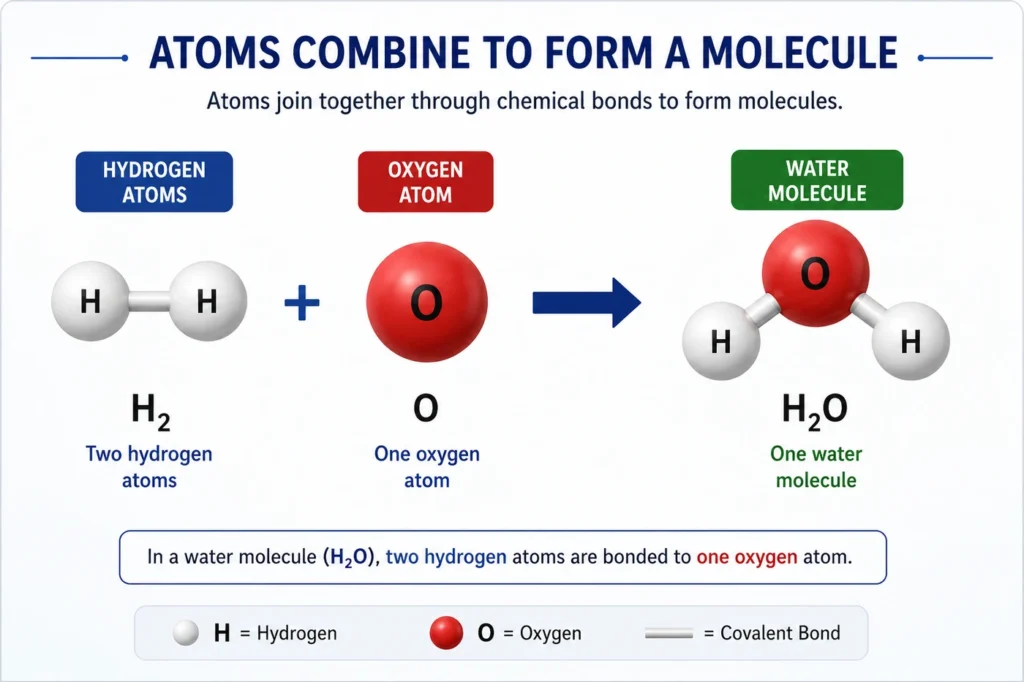
A molecule is a group of atoms held together by chemical bonds and acting as a distinct unit. In covalent substances, a molecule is the smallest unit that retains the characteristic chemical properties of the substance. For example, one water molecule contains two hydrogen atoms and one oxygen atom, represented by H₂O. Atoms in a molecule are connected through chemical bonds, commonly covalent bonds, in which atoms share electrons. Molecular formulas show which elements are present and how many atoms of each element are present. For example: H₂ contains two hydrogen atoms. O₂ contains two oxygen atoms. H₂O contains two hydrogen atoms and one oxygen atom. CO₂ contains one carbon atom and two oxygen atoms.
Important note: In strict modern chemical terminology, an isolated helium atom (He), for example, is an atom rather than a molecule. However, many introductory chemistry textbooks use the term monatomic molecule for elements such as helium and neon that exist as individual atoms. This article follows that common educational classification.
Classification of Molecules
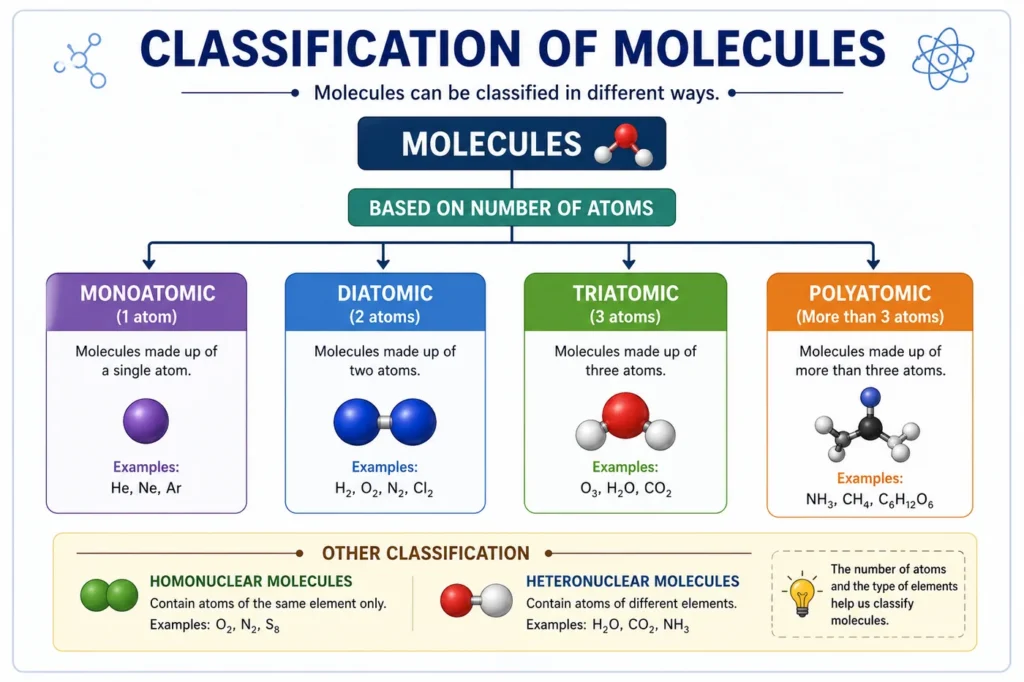
The most useful introductory classification is based on atomicity, meaning the number of atoms present in one molecular unit. Based on the number of atoms, types of molecules are; Monoatomic, diatomic, triatomic, polyatomic. They can also be classified according to whether the atoms are from the same element or different elements.
Monoatomic Molecules
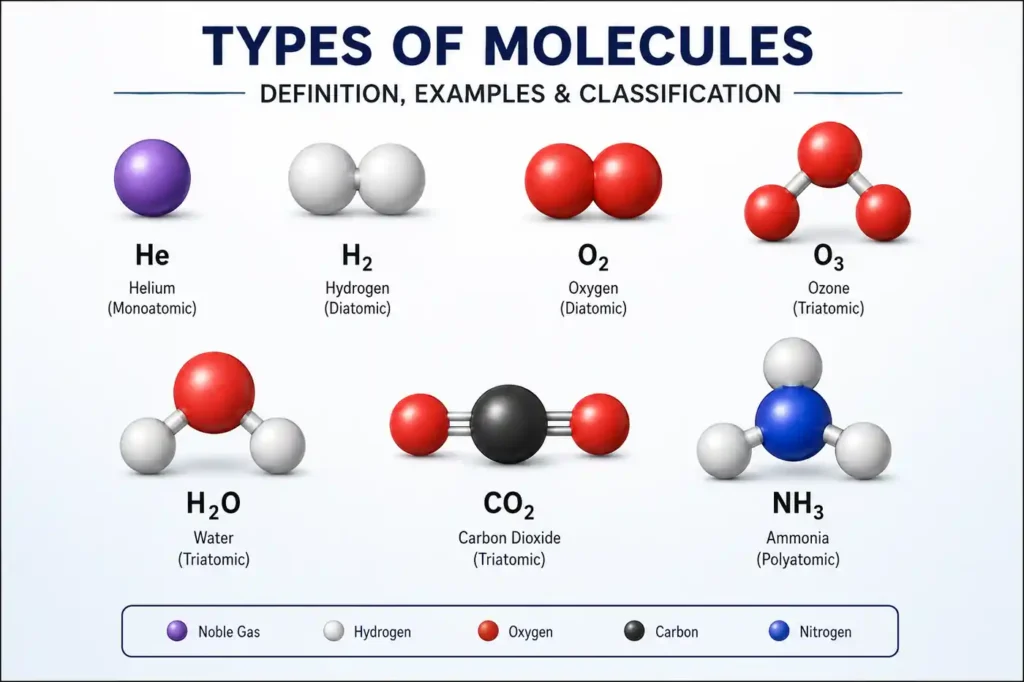
The prefix mono- means one. Monoatomic substances consist of individual atoms rather than bonded groups of atoms. The noble gases are common examples. Helium, neon, argon, krypton, xenon, and radon normally exist as individual atoms under ordinary conditions. They are therefore commonly described in elementary chemistry as monoatomic gases. For example, one helium particle contains only one helium atom:
| Element | Symbol | Atomic Units |
|---|---|---|
| Helium | He | 1 |
| Neon | Ne | 1 |
| Argon | Ar | 1 |
| Krypton | Kr | 1 |
| Xenon | Xe | 1 |
He → 1 atom This is different from oxygen, where two oxygen atoms are bonded together to form O₂.
Diatomic Molecules
The prefix di- means two. A diatomic molecule contains two atoms The two atoms may be identical or may belong to different elements. Seven elements commonly exist as diatomic molecules under ordinary conditions: H₂, N₂, O₂, F₂, Cl₂, Br₂, and I₂. For example, an oxygen molecule contains two oxygen atoms: O₂ → 2 oxygen atoms. Diatomic molecules can also contain atoms of different elements. Examples include hydrogen chloride (HCl) and carbon monoxide (CO). When the two atoms are the same, such as in H₂ or O₂, the molecule is called homonuclear. When they are different, such as HCl or CO, it is called heteronuclear.
Triatomic Molecules
The prefix tri- means three. A triatomic molecule contains three atoms. The atoms may be from the same element or from different elements. For example: O₃ — ozone, H₂O — water, CO₂ — carbon dioxide, NO₂ — nitrogen dioxide are triatomic types of molecules. Ozone (O₃) contains three oxygen atoms, while water (H₂O) contains two hydrogen atoms and one oxygen atom. Therefore, both are triatomic types of molecules in terms of the total number of atoms in each molecule, even though their elements are different.
Polyatomic Molecules
The prefix poly- means many. Polyatomic types of molecules contain more than two atoms. In some elementary classifications, triatomic molecules are listed separately and polyatomic molecules are used for molecules containing more than three atoms. Examples include: NH₃ — ammonia, CH₄ — methane, P₄ — phosphorus, S₈ — sulfur, C₆H₁₂O₆ — glucose. Elemental phosphorus commonly occurs as P₄ and sulfur as S₈, demonstrating that some elements can exist naturally as polyatomic molecular forms.
Classification Based on the Type of Atoms
Another useful way to classify molecules is to ask a simple question: Do the molecules contain atoms of the same element or different elements? On this base there are two types of molecules.
Homonuclear Molecules
A homonuclear molecule contains atoms of only one chemical element. Examples include: H₂ — hydrogen, O₂ — oxygen, N₂ — nitrogen, O₃ — ozone, P₄ — phosphorus, S₈ — sulfur. Although these molecules contain several atoms, all of those atoms belong to the same element.
Heteronuclear Molecules
A heteronuclear molecule contains atoms of two or more different elements. Examples include: H₂O — water, CO₂ — carbon dioxide, NH₃ — ammonia, CH₄ — methane, HCl — hydrogen chloride. For example, H₂O is heteronuclear because it contains hydrogen and oxygen atoms.
Quick Comparison of Types of Molecules
| Types of Molecules | Meaning | Examples |
|---|---|---|
| Monoatomic | One atom | He, Ne, Ar |
| Diatomic | Two atoms | H₂, O₂, N₂ |
| Triatomic | Three atoms | O₃, H₂O, CO₂ |
| Polyatomic | More than two atoms; often used for larger molecular units | NH₃, P₄, S₈, C₆H₁₂O₆ |
| Homonuclear | Atoms of the same element | H₂, O₂, P₄ |
| Heteronuclear | Atoms of different elements | H₂O, CO₂, NH₃ |
Why Is the Classification of Molecules Important?
Learning types of molecules helps us understand chemical formulas and molecular structures more easily. When you see O₂, you immediately know that it contains two oxygen atoms. When you see H₂O, you can identify three atoms belonging to two different elements. This classification also provides a foundation for understanding chemical bonding, molecular geometry, molecular mass, chemical reactions, and the properties of substances. For example, the formula C₆H₁₂O₆ tells us that one glucose molecule contains 24 atoms in total: six carbon, twelve hydrogen, and six oxygen atoms.
Conclusion
Molecules can be classified in different ways depending on the property being considered. Based on the number of atoms, types of molecules are monoatomic, diatomic, triatomic, or polyatomic. Based on the elements present, types of molecules are homonuclear or heteronuclear. Remembering a few simple examples makes this classification much easier: He represents a single-atom unit, O₂ contains two atoms, O₃ contains three atoms, and H₂O contains three atoms belonging to two different elements. Once you understand how to count the atoms in a chemical formula, identifying the major types of molecule becomes much simpler.
Frequently Asked Questions
1. What is a molecule in chemistry?
A molecule is a distinct group of atoms held together by chemical bonds. In covalent substances, it is the smallest unit that retains the characteristic chemical properties of the substance.
2. What are the main types of molecules?
At an introductory level, molecules can be classified according to atomicity as monoatomic, diatomic, triatomic, and polyatomic. They can also be classified as homonuclear or heteronuclear based on the elements present.
3. What is a diatomic molecule?
A diatomic molecule contains two atoms. The atoms may be identical, as in O₂, or different, as in HCl.
4. Is H₂O a triatomic molecule?
Yes. One H₂O molecule contains three atoms: two hydrogen atoms and one oxygen atom. It is also a heteronuclear molecule because it contains atoms of different elements.
5. What are examples of polyatomic molecules?
Common examples include NH₃, CH₄, P₄, S₈, and C₆H₁₂O₆. These molecular units contain more than two atoms.
6. What is a homonuclear molecule?
A homonuclear molecule contains atoms of only one element. Examples include H₂, N₂, O₂, P₄, and S₈.
7. What is a heteronuclear molecule?
A heteronuclear molecule contains atoms belonging to two or more different elements. Examples include H₂O, CO₂, NH₃, and HCl.