Table of Contents
Chemistry becomes much easier to understand when elements are arranged in an organized way. The periodic table of elements provides this organization by placing chemical elements according to their atomic numbers and electron configurations. It allows us to compare elements, identify similarities, and predict how they may behave in chemical reactions. Whether you are learning basic chemistry or studying more advanced concepts, understanding the periodic table of elements is an important foundation. Its rows, columns, groups, and blocks provide useful information about the properties of elements.
What is the Periodic Table of Elements?
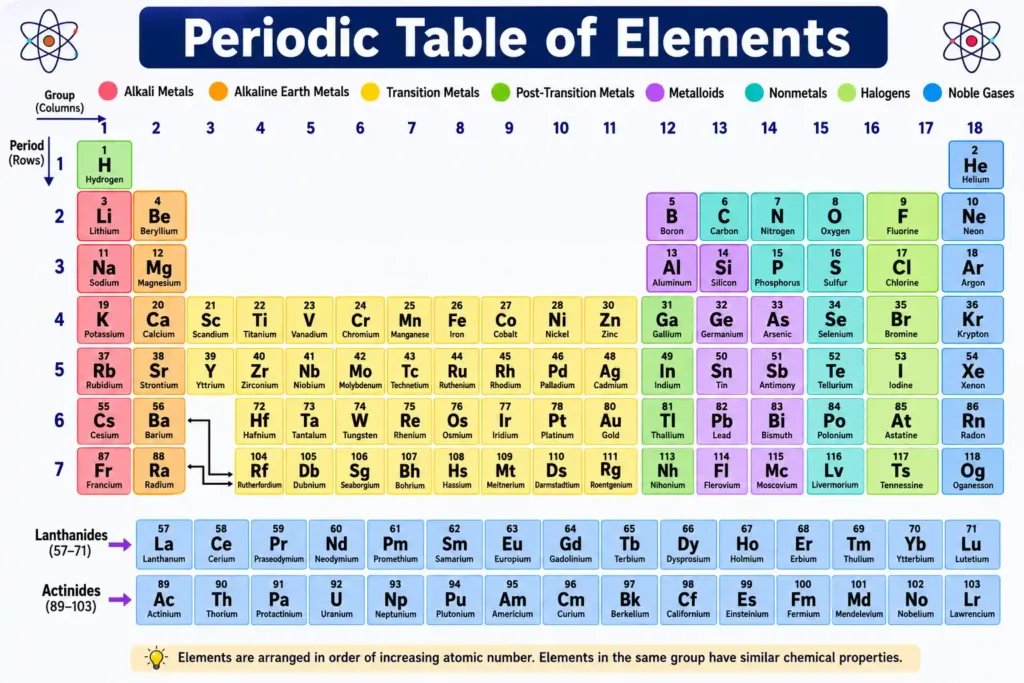
The periodic table of elements is a systematic arrangement of chemical elements in order of increasing atomic number. The atomic number represents the number of protons present in the nucleus of an atom. Each element is represented by a chemical symbol and has a specific position in the table. For example, hydrogen has the symbol H and atomic number 1, while oxygen has the symbol O and atomic number 8. The arrangement is not simply a list of elements. Elements with similar chemical properties are placed in the same vertical columns, making it possible to identify patterns in their behavior.
A Brief History of the Periodic Table
The development of the periodic table of elements took place over many years. Scientists noticed that certain elements showed similarities and attempted to organize them into useful systems. In 1869, Dmitri Mendeleev published a periodic table in which elements were primarily arranged according to their atomic masses. One of the important strengths of his periodic table of elements was that he left gaps for elements that had not yet been discovered and predicted some of their properties. Later, Henry Moseley demonstrated that atomic number was a more fundamental basis for arranging elements. The modern periodic law therefore uses increasing atomic number rather than atomic mass. The table has continued to develop as new elements have been discovered and confirmed.
How Is the Periodic Table Organized?
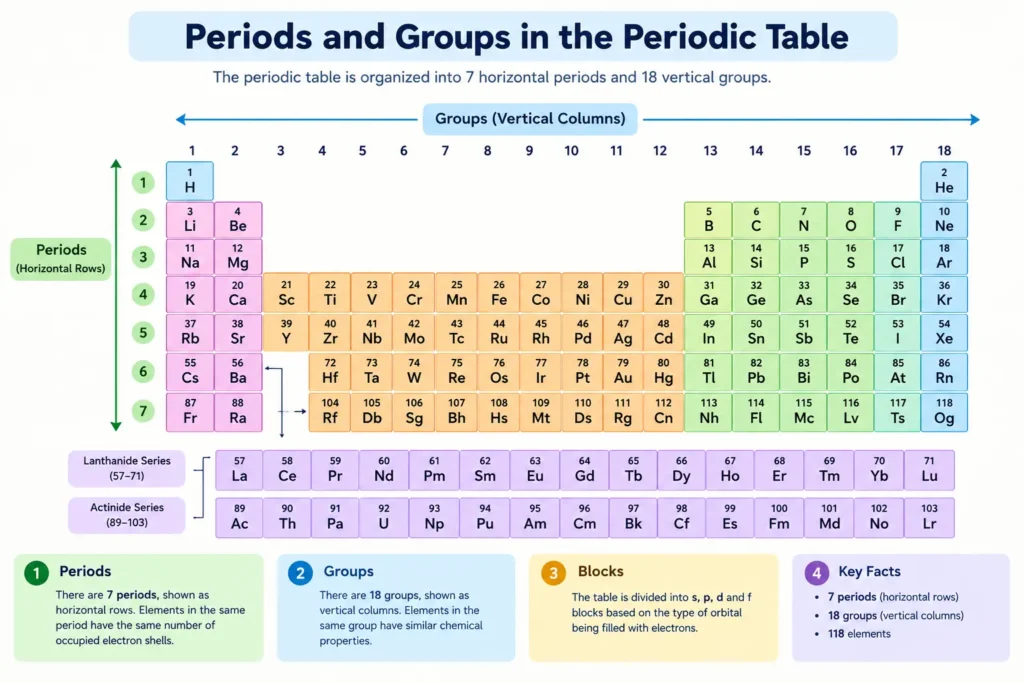
The modern periodic table of elements contains 118 officially recognized elements. These elements are arranged into horizontal rows called periods and vertical columns called groups. There are 7 periods and 18 groups.
| Feature | Meaning |
|---|---|
| Atomic number | Number of protons in an atom |
| Period | Horizontal row in the table |
| Group | Vertical column in the table |
| Blocks | s, p, d and f regions |
| Elements | 118 recognized chemical elements |
The position of an element gives clues about its electron arrangement and chemical properties.
Periods
The seven horizontal rows are called periods. As we move from left to right across a period, the atomic number increases by one. Elements in the same period have the same number of occupied principal electron shells, although their chemical properties can be quite different. For example, sodium and chlorine are both found in the third period, but sodium is a reactive metal while chlorine is a reactive nonmetal.
Groups
The 18 vertical columns are called groups. Elements within many groups have similar chemical properties because they have related outer-electron arrangements. Some groups have commonly used names:
| Group | Common name | Examples |
|---|---|---|
| 1 | Alkali metals | Lithium, sodium, potassium |
| 2 | Alkaline earth metals | Magnesium, calcium, barium |
| 17 | Halogens | Fluorine, chlorine, bromine |
| 18 | Noble gases | Helium, neon, argon |
Blocks of the Periodic Table
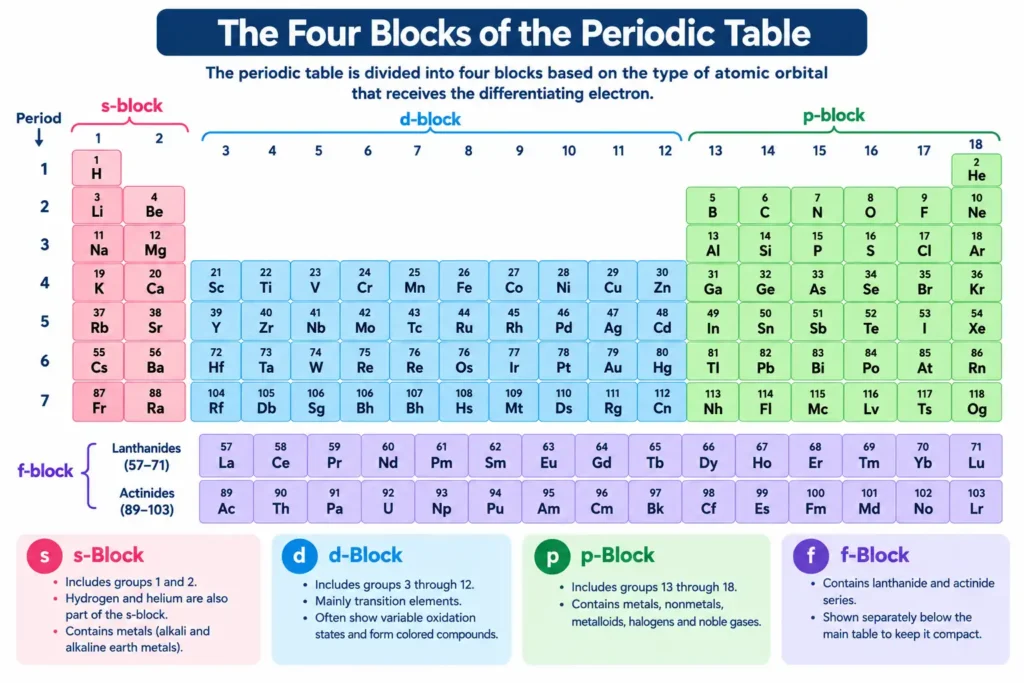
Elements can also be divided into four blocks according to the type of atomic orbital receiving the differentiating electron.
s-Block
The s-block mainly includes groups 1 and 2. Hydrogen and helium are also associated with the s-block based on their electron configurations.
p-Block
The p-block includes groups 13 through 18. It contains metals, metalloids, nonmetals, halogens, and noble gases.
d-Block
The d-block consists mainly of the transition elements. These elements occupy groups 3 through 12 and commonly show variable oxidation states and form colored compounds.
f-Block
The f-block contains the lanthanide and actinide series. These elements are usually displayed separately below the main body of the table to keep the table compact.
Metals, Non-metals and Metalloids
Another useful way to study elements in the periodic table is to classify them as metals, non-metals, or metalloids. Metals generally have a shiny appearance, conduct heat and electricity, and tend to lose electrons during chemical reactions. Most elements in the periodic table are metals. Non-metals generally have different properties. Many are poor conductors of heat and electricity, and they often gain or share electrons when forming compounds. Metalloids have properties that fall between those of metals and nonmetals. Silicon and germanium are familiar examples. The boundary between metals and nonmetals is often represented by a zigzag or staircase line on periodic tables.
Periodic Trends
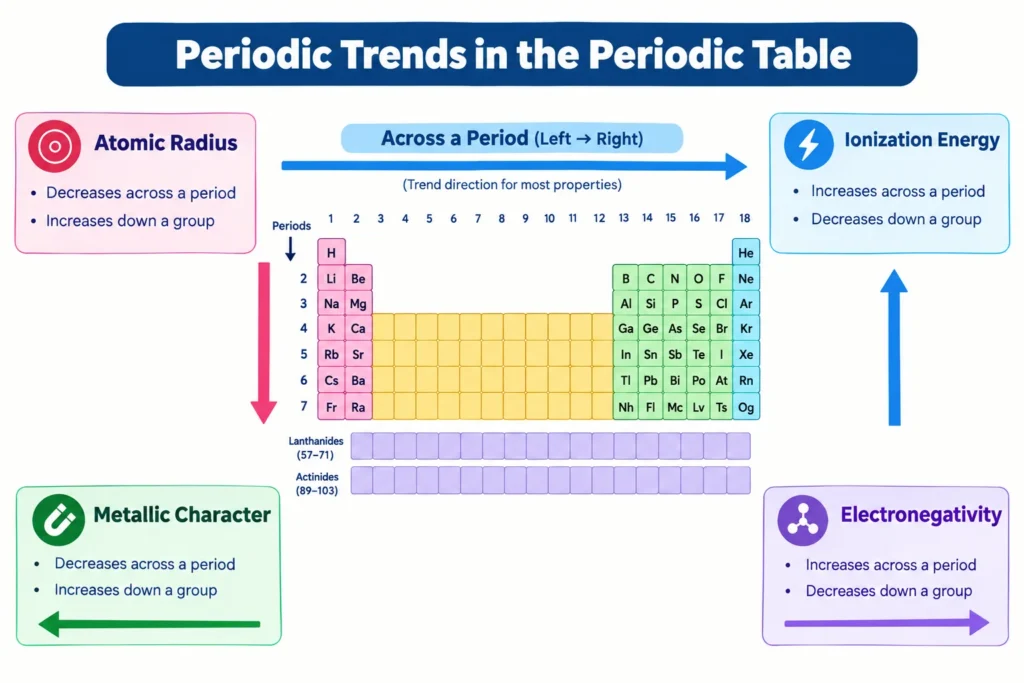
One of the most useful features of the table is that several physical and chemical properties follow recognizable patterns. These patterns are called periodic trends. Important trends include atomic radius, ionization energy, electronegativity, and metallic character.
| Property | Across a period | Down a group |
|---|---|---|
| Atomic radius | Generally decreases | Generally increases |
| Ionization energy | Generally increases | Generally decreases |
| Electronegativity | Generally increases | Generally decreases |
| Metallic character | Generally decreases | Generally increases |
These trends are useful because they allow chemists to make predictions without memorizing the properties of every element individually. For example, atomic size generally becomes larger down a group because additional electron shells are added. Across a period, increasing nuclear charge generally pulls the electrons closer to the nucleus.
Why Is the Periodic Table Important?
The periodic table of elements is much more than a reference chart. It helps organize a large amount of chemical information in a relatively simple format. It helps students and scientists:
- Identify elements and their symbols
- Compare chemical and physical properties
- Understand relationships between elements
- Predict chemical behavior
- Study electron configurations
- Understand periodic trends
- Classify elements into different groups and blocks
- Connect atomic structure with chemical properties
For example, knowing that an element belongs to the halogen group immediately provides useful information about its general chemical behavior.
How to Read an Element’s Position
An element’s location can provide several clues about its characteristics. Start by identifying its group and period. Then determine whether it belongs to the s, p, d, or f-block. Its position can also help determine whether it is generally a metal, nonmetal, or metalloid.
The atomic number provides another important piece of information because it tells us the number of protons in a neutral atom and determines the identity of the element.
By combining these details, the periodic table becomes a powerful tool for understanding atomic structure and chemical behavior.
Conclusion
The periodic table of elements brings all known chemical elements into a logical system based mainly on atomic number and recurring chemical properties. Its groups, periods, blocks, and trends make it possible to recognize relationships between elements and predict their general behavior. Learning how to read the table is therefore an important step in chemistry. Instead of memorizing every element separately, you can use its organization to understand why elements behave differently and why some of them share similar properties. Once the basic structure becomes familiar, topics such as electron configuration, chemical bonding, reactivity, periodic trends, and compound formation become much easier to study.
FAQs
1. What is the periodic table of elements?
The periodic table of elements is an organized arrangement of chemical elements according to increasing atomic number and recurring chemical properties.
2. How many elements are in the periodic table?
There are currently 118 officially recognized chemical elements.
3. How many groups are in the periodic table?
There are 18 vertical groups.
4. How many periods are in the periodic table?
The modern table has seven horizontal periods.
5. Why are elements placed in groups?
Elements in the same group often have similar chemical properties because their outer-electron arrangements are related.
6. What are the four blocks of the periodic table?
The four blocks are the s-block, p-block, d-block, and f-block.
7. Who created the first periodic table?
Dmitri Mendeleev is widely credited with developing the first widely recognized periodic table in 1869.
8. What is the basis of the modern periodic table of elements?
The modern periodic table of elements is arranged according to increasing atomic number.
9. What are periodic trends?
Periodic trends are predictable changes in properties such as atomic radius, ionization energy, and electronegativity across periods and down groups.
10. Why is the periodic table of elements important?
It helps us organize chemical elements, compare their properties, understand atomic structure, and predict their general chemical behavior.