Table of Contents
Elements exhibit different physical and chemical properties depending on their atomic structure and the way their electrons behave. Some elements conduct electricity efficiently and can be shaped into wires, while others are brittle solids or gases with poor electrical conductivity. Between these two groups are elements that display characteristics of both.
Based on their general properties, elements are commonly classified as metals, nonmetals, and metalloids. Understanding these categories helps explain how elements behave during chemical reactions, form different types of bonds, and contribute to materials used in everyday life and modern technology.
In this guide, we will explore the physical and chemical properties of metals, nonmetals and metalloids, examine their differences, and discuss important examples and applications.
1. Properties of Metals
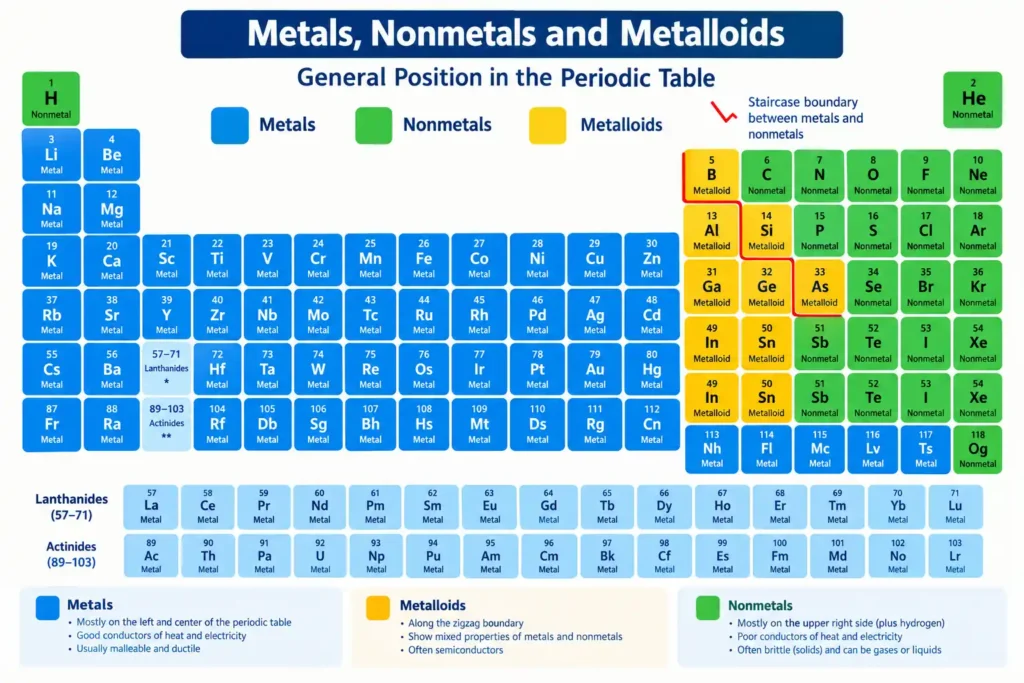
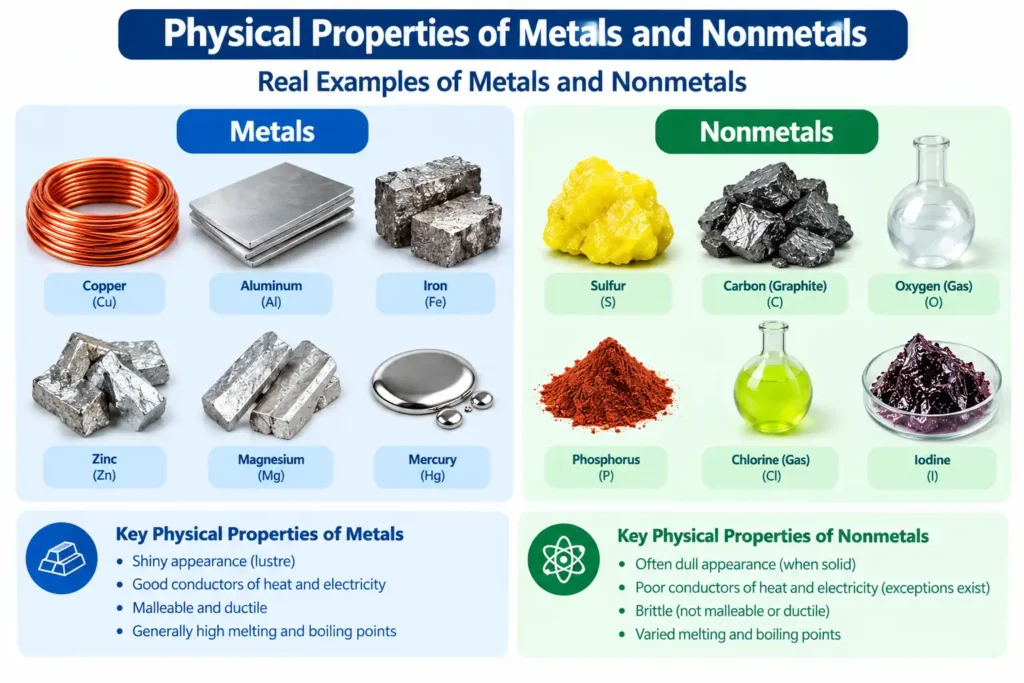
Metals make up most of the elements in the periodic table. They are found mainly on the left and in the center of the table. Iron, copper, aluminum, sodium, magnesium, and zinc are familiar examples. Their characteristic properties are closely related to metallic bonding, in which positively charged metal ions are held together by a structure containing delocalized electrons.
1.1 Physical Properties of Metals
Metals have several characteristic physical properties, although not every metal exhibits all of them.
Metallic lustre: Most metals have a shiny surface when freshly cut or polished. Their interaction with visible light produces the characteristic metallic appearance.
Electrical conductivity: Metals are generally good conductors of electricity because their delocalized electrons can move through the solid structure and carry electric charge. Copper is widely used in electrical wiring, while aluminum is used in power transmission lines.
Thermal conductivity: Metals generally transfer heat efficiently because mobile electrons help transport thermal energy through their structures. This property makes aluminum and copper useful in cookware and heat exchangers.
Malleability: Metals can usually be hammered or rolled into thin sheets without breaking. This occurs because layers of metal atoms can shift while metallic bonding continues to hold the structure together.
Ductility: Many metals can be drawn into wires. Copper’s ductility makes it particularly suitable for electrical cables.
Melting and boiling points: Many metals have relatively high melting and boiling points because their metallic bonding requires considerable energy to overcome. However, these temperatures vary considerably. Mercury is liquid at room temperature, while some metals have comparatively low melting points.
Density and hardness: Many metals are dense and hard, but these are not universal characteristics. Sodium is relatively soft, whereas iron is much harder. Density also varies significantly among metals.
1.2 Chemical Properties of Metals
The chemical behavior of metals is strongly influenced by their tendency to lose electrons and form positively charged ions, called cations.
Reaction with oxygen
Many metals react with oxygen to form metal oxides. For example, magnesium burns in oxygen with a bright white flame and produces magnesium oxide.
Mg + O2 -> MgO
Metal oxides are often basic, although some are amphoteric, meaning they can react with both acids and bases. Aluminum oxide is an example of an amphoteric oxide.
Reaction with water
Some metals react with water to produce metal hydroxides or oxides and hydrogen gas. The products depend on the metal and the reaction conditions.
For example, sodium reacts vigorously with water to form sodium hydroxide and hydrogen.
Na + H2O -> NaOH + H2
Less reactive metals, such as copper, do not react readily with cold water.
Reaction with acids
Many metals react with dilute acids to produce a salt and hydrogen gas. For example, zinc reacts with dilute hydrochloric acid to form zinc chloride and hydrogen.
Zn + HCl -> ZnCl2 + H2
However, not every metal releases hydrogen from dilute acids. Copper, for example, does not react with dilute hydrochloric acid under ordinary conditions.
Formation of ions
Metals commonly lose electrons during ionic reactions. Magnesium loses two electrons to form a magnesium ion:
Mg -> Mg+2 + 2e–
This electron loss helps explain the formation of ionic compounds between metals and suitable nonmetals.
1.3 Examples and Uses of Metals
The properties of metals determine their practical applications.
- Iron: Used in construction, machinery, and steel production because of its strength and versatility.
- Copper: Used in electrical wiring because of its high electrical conductivity and ductility.
- Aluminum: Used in aircraft, transport, packaging, and construction because of its low density and corrosion resistance.
- Zinc: Used to protect iron and steel from corrosion through galvanization.
- Magnesium: Used in lightweight alloys and certain applications requiring low mass.
2. Properties of Nonmetals
Nonmetals are located mainly in the upper-right region of the periodic table, with hydrogen as an important exception because it is positioned on the left. Examples include oxygen, nitrogen, carbon, sulfur, phosphorus, and chlorine.
Nonmetals differ from metals in their physical properties and typical chemical behavior. Their atoms often gain electrons or share electrons with other atoms when forming compounds.
2.1 Physical Properties of Nonmetals
Nonmetals do not share one uniform physical appearance or state. Their properties vary according to their atomic and molecular structures.
Physical state: At room temperature, nonmetals can exist as solids, liquids, or gases. Carbon and sulfur are solids, bromine is a liquid, and oxygen and nitrogen are gases.
Appearance: Many nonmetals have a dull appearance when solid. However, iodine has a noticeable lustre, demonstrating that this property is not an absolute distinction between metals and nonmetals.
Electrical conductivity: Most nonmetals are poor electrical conductors because they lack the freely mobile electrons characteristic of metals. Graphite, an allotrope of carbon, is an important exception because it contains electrons that can move along its layered structure.
Thermal conductivity: Most nonmetals conduct heat less effectively than metals, although their thermal properties vary. Diamond, for example, conducts heat exceptionally well despite being a nonmetal.
Brittleness: Solid nonmetals are generally brittle. Unlike many metals, they cannot normally be hammered into thin sheets or drawn into wires without breaking.
Melting and boiling points: These values vary considerably. Many molecular nonmetals have relatively low melting and boiling points because the forces between their molecules are comparatively weak. Network solids such as diamond have very high melting temperatures because their atoms are connected by strong covalent bonds throughout an extended structure.
2.2 Chemical Properties of Nonmetals
The chemical behavior of nonmetals depends on their electron configuration and the types of bonds they form.
Reaction with oxygen
Many nonmetals react with oxygen to form nonmetal oxides. Some of these oxides produce acidic solutions when they react with water.
For example, sulfur burns in oxygen to form sulfur dioxide:
S + O2 -> SO2
Sulfur dioxide can react with water to produce sulfurous acid:
SO2 + H2O -> H2SO3
However, not all nonmetal oxides are acidic. Carbon monoxide is a neutral oxide, illustrating the importance of considering individual compounds.
Electron gain and ion formation
Some nonmetals gain electrons to form negative ions, called anions. For example, a chlorine atom can gain one electron to form a chloride ion:
Cl + e– -> Cl–
Chloride ions combine with suitable positive ions to form ionic compounds, such as sodium chloride.
Covalent bond formation
Many nonmetals share electrons to achieve more stable electronic arrangements. This sharing produces covalent bonds.
For example, two hydrogen atoms share electrons with an oxygen atom to form a water molecule. Similarly, carbon forms covalent bonds in compounds such as methane and carbon dioxide.
Reaction with metals
Many nonmetals react with metals to form ionic compounds. Sodium reacts with chlorine to form sodium chloride:
Na + Cl2 -> 2NaCl
In this reaction, sodium transfers electrons to chlorine, producing oppositely charged ions that attract one another.
2.3 Examples and Uses of Nonmetals
- Oxygen: Essential for aerobic respiration and widely used in medical and industrial processes.
- Nitrogen: Used in fertilizer production and to provide inert atmospheres in industrial applications.
- Carbon: Present in fuels, organic compounds, graphite, and diamond.
- Sulfur: Used in sulfuric acid production, rubber processing, and various industrial applications.
- Chlorine: Used in water disinfection and the manufacture of important chemicals.
3. Properties of Metalloids
Metalloids are elements that exhibit a combination of metallic and nonmetallic characteristics. Their properties often fall between those typically associated with metals and nonmetals, although no single set of properties applies equally to every metalloid.
Commonly recognized examples include silicon, germanium, boron, arsenic, and antimony. The classification of certain elements can vary between educational and scientific sources.
3.1 Physical Properties of Metalloids
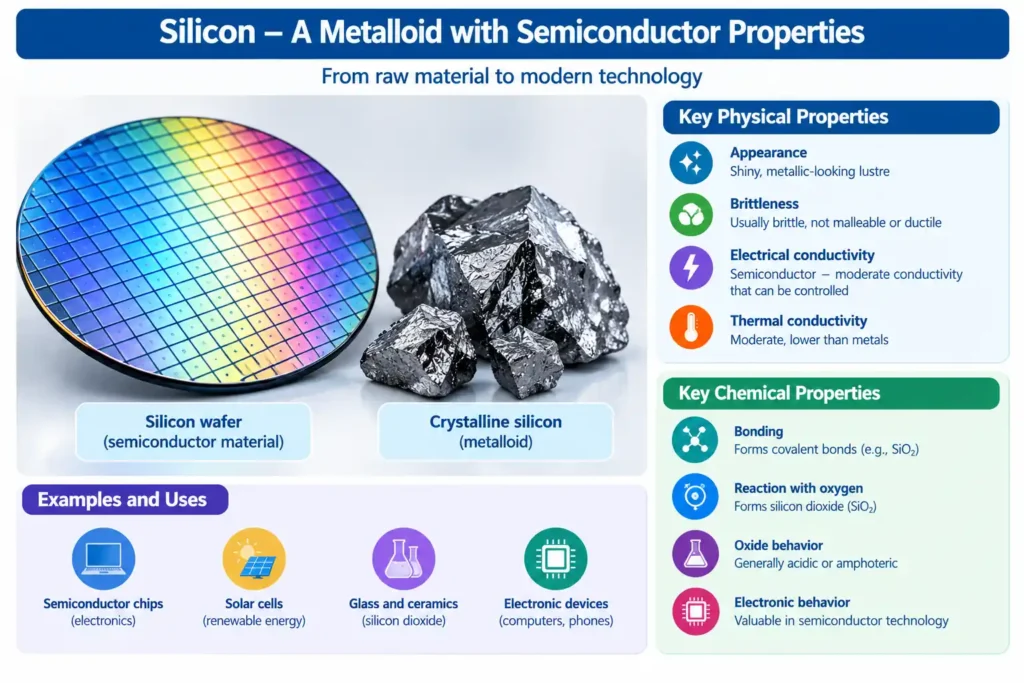
Appearance: Many metalloids have a metallic-looking lustre. Silicon, for example, has a shiny gray appearance.
Brittleness: Unlike typical malleable metals, solid metalloids are generally brittle. They usually fracture rather than being drawn into wires or hammered into thin sheets.
Electrical conductivity: Many metalloids, particularly silicon and germanium, are semiconductors. Their electrical conductivity is between that of good conductors and typical insulators under suitable conditions.
A semiconductor’s conductivity can be controlled through temperature changes, the addition of small quantities of impurities, and the application of electric fields. This behavior makes semiconductor materials important in electronic devices.
Mechanical properties: Metalloids often differ from metals in hardness, brittleness, and how they respond to mechanical stress. Their properties depend on their crystal structures and bonding.
3.2 Chemical Properties of Metalloids
The chemical behavior of metalloids varies with the element and the reaction conditions.
Bond formation: Many metalloids form covalent bonds. Silicon, for example, forms an extended covalent structure in crystalline silicon. This structure is central to its semiconductor properties.
Reaction with oxygen: Several metalloids form oxides when they react with oxygen. Silicon reacts with oxygen to form silicon dioxide:
Si + O2 -> SO2
Silicon dioxide is an important material found in quartz and many types of glass.
Oxide behavior: Some metalloid oxides show acidic or amphoteric behavior. For example, arsenic trioxide can exhibit amphoteric behavior, while silicon dioxide is an acidic oxide in its chemical behavior. These patterns are useful generalizations, not universal rules for every metalloid.
Electronic behavior: Metalloids such as silicon and germanium have electronic structures that make them valuable in semiconductor technology. Their behavior cannot be explained simply by saying that they sometimes gain and sometimes lose electrons; bonding, crystal structure, and energy bands are also important.
3.3 Examples and Uses of Metalloids
- Silicon: Used in semiconductor chips, solar cells, and glass-related materials.
- Germanium: Used in selected electronic devices, infrared optics, and specialized semiconductor applications.
- Boron: Used in borosilicate glass, certain detergents, and specialized high-strength materials.
- Antimony: Used in some alloys and flame-retardant systems.
- Arsenic: Used in certain specialized semiconductor materials, although its compounds require careful handling because many are highly toxic.
4. Comparison between properties of Metals, Nonmetals, and Metalloids
Although these categories have characteristic properties, their boundaries are not absolute. The following table summarizes their common differences.
| Property | Metals | Nonmetals | Metalloids |
|---|---|---|---|
| Typical position | Left and center of the periodic table | Mainly upper-right, plus hydrogen | Generally near the zigzag boundary |
| Appearance | Usually lustrous | Often dull when solid | Often metallic-looking |
| Electrical conductivity | Generally high | Generally low, with exceptions | Often intermediate or semiconducting |
| Malleability | Many are malleable | Solid forms are generally brittle | Generally brittle |
| Ductility | Many are ductile | Generally not ductile | Generally not ductile |
| Physical state at room temperature | Mostly solids; mercury is liquid | Solids, liquids, and gases | Commonly solids |
| Electron behavior | Often lose electrons | Often gain or share electrons | Frequently form covalent bonds; behavior varies |
| Common bonding | Metallic and ionic in suitable compounds | Often covalent; some form ions | Often covalent |
| Oxide behavior | Often basic; some amphoteric | Often acidic or neutral | Can be acidic or amphoteric |
| Examples | Fe, Cu, Al, Mg | O, N, C, S, Cl | Si, Ge, B, As, Sb |
These are general trends for properties of metals, nonmetals and metalloids rather than strict rules. For example, graphite is a conducting nonmetal, aluminum oxide is amphoteric, and the physical and chemical properties of individual metalloids vary.
5. Why Do These Elements Have Different Properties?
The differences between metals, nonmetals, and metalloids are closely related to their electronic structures, bonding, and arrangements of atoms.
5.1 Role of Valence Electrons
Valence electrons are the electrons involved in many chemical bonds and reactions. Metals often lose valence electrons relatively easily, forming positive ions. Nonmetals frequently gain electrons or share them through covalent bonding.
However, the number of valence electrons alone does not explain every property. The energy required to remove electrons, the attraction between nuclei and electrons, and the stability of the resulting structures also influence chemical behavior.
5.2 Metallic Bonding and Conductivity
In metals, delocalized electrons can move through the solid structure. Their mobility helps explain electrical conductivity and contributes to thermal conductivity.
Metallic bonding also allows layers of atoms to shift without completely destroying the bonding structure. This helps explain why many metals are malleable and ductile.
5.3 Covalent Structures and Semiconductor Behavior
Nonmetals and metalloids often form covalent bonds, but the resulting structures can be very different.
Some nonmetals form small molecules, such as oxygen and nitrogen, while others form extended covalent networks, such as diamond. These structural differences help explain their different melting points and mechanical properties.
In silicon and germanium, the arrangement of electrons in the solid creates an energy gap between occupied and unoccupied electronic states. This gap allows their electrical conductivity to be controlled, making them useful semiconductor materials.
6. Common Exceptions and Misconceptions
Several exceptions show why the properties of metals nonmetals and metalloids should be understood as general patterns rather than absolute rules.
- Mercury is a liquid metal: It is liquid at ordinary room temperature, unlike most metals.
- Graphite conducts electricity: Although carbon is a nonmetal, graphite contains mobile electrons that allow it to conduct electricity.
- Diamond conducts heat efficiently: Its extended covalent structure allows heat to travel efficiently through the material, even though it is an electrical insulator under ordinary conditions.
- Not all metal oxides are basic: Aluminum oxide and zinc oxide are amphoteric.
- Metalloid classification can vary: Some elements are classified differently depending on the source and the criteria being used.
Recognizing these exceptions leads to a more accurate understanding of periodic trends and chemical behavior.
Conclusion
Metals, nonmetals, and metalloids differ in their physical properties, chemical reactions, bonding, and electronic behavior. Metals are generally good conductors and often lose electrons, while nonmetals commonly form covalent bonds or gain electrons. Metalloids exhibit selected characteristics of both categories, with some showing useful semiconductor behavior.
These differences between properties of metals nonmetals and metalloids explain why particular elements are suitable for applications ranging from electrical wiring and structural materials to glass production and advanced electronic devices. Understanding the relationship between atomic structure and observable properties provides a foundation for studying chemical bonding, periodic trends, and the behavior of materials.